

Domain-Specific vs. General-Purpose AI for European HTA Dossier Generation
Everyone in market access, HEOR, and regulatory affairs is asking the same question right now: How feasible is it to generate a regulatory or HTA submission dossier with AI today—and where does it still break? Ahead of ISPOR Europe 2026 in Vienna (Poster HTA86), we built HTA-Bench across eight complete, authority-accepted G-BA AMNOG and ICH CTD dossiers and calibrated our evaluation against 180 blinded ratings by 17 HTA experts.
Why We Built HTA-Bench: Testing Real-World Feasibility Beyond Demos and Toy Benchmarks
Depending on whether you walk the poster hall at ISPOR or follow frontier AI model launches, you get two completely disconnected answers to whether AI can draft a regulatory dossier.
At ISPOR: Surge in GenAI Posters, Zero Full-Dossier Benchmarks
To quantify what the HEOR community has actually tested, we queried the Crossref metadata index across all conference abstract supplements of Value in Health (Volumes 24–29, 2021–2026) and classified every indexed ISPOR and ISPOR Europe poster using keyword filters for general AI/ML/NLP, Generative AI/LLMs, and HTA/JCA/GVD dossier drafting. As Figure 1 shows, both general AI research and Generative AI/LLM posters have risen steeply over the past five years, with a sharp surge in LLM studies starting in 2024.
Yet out of those 284 GenAI posters, only 20 focused on regulatory or HTA dossier drafting. Those 20 studies demonstrated encouraging proofs of concept—such as RAG-based Global Value Dossier (GVD) co-authoring accelerators reporting ~60%–70% draft time reductions on individual disease-burden chapters[1–3], proof-of-concept generation for Canadian CADTH reimbursement forms[4], comparative analyses of traditional versus AI-assisted HTA dossier writing[5, 6], and automated PICO mapping, RAG evidence synthesis, or survival extraction for EU Joint Clinical Assessments[7–10].
In our own empirical studies at ISPOR Europe 2025—analyzing 12,500 real writer–AI messages[11] and interviewing medical writers on GenAI adoption[12]—we saw why teams are both excited and cautious. Writers already use AI heavily for targeted drafting and translation, but as one experienced AMNOG writer told us: "It saves time for strategic thinking, but it's dangerous to stop thinking—one has to read everything properly."
The catch is that not a single one of those 284 posters evaluated end-to-end, multi-module dossier generation against real, authority-accepted submissions. Almost all industry claims still rest on isolated chapter pilots, self-reported time savings, or uncalibrated LLM judges.
In the LLM Benchmarking World: Why Frontier & Knowledge-Work Benchmarks Fall Short
When AI labs release a new frontier model or coding agent, they point to high scores on general academic, coding, or knowledge-work benchmarks. None of them measure what it takes to produce a submission-ready regulatory dossier:
- Real-World Knowledge Work & Office Benchmarks[13–15]: Measure self-contained 1–4 hour digital knowledge-work deliverables such as spreadsheets, short memos, slide decks, and browser workflows. They do not test whether a system can synthesize 1,000+ pages of clinical trial reports into a 50,000-word statutory Word dossier where every patient count and hazard ratio must match across chapters.
- Regulatory & HEOR Retrieval Benchmarks[16, 17]: Measure single-turn question answering and paragraph-level citation retrieval over regulations or HEOR abstracts—including the EU AI Act Retrieval Challenge[16], where Regulaido recently ranked #1 at 92% accuracy. Retrieval accuracy is a necessary prerequisite, but knowing how to answer an isolated question is far simpler than populating an entire statutory submission template without losing table structure or citation traceability.
- Medical Exam & Clinical Benchmarks[18–20]: Measure textbook clinical recall, single-abstract yes/no QA, or short multi-turn medical advice conversations. They test internal medical knowledge rather than strict adherence to primary Clinical Study Reports (CSRs) and German Fachinformationen (SmPCs).
- Software Engineering & General Agent Benchmarks[21–23]: Test whether an agent can patch a codebase, browse the web, or call APIs. As we show in Part 1, a coding CLI that excels at software engineering will happily write a Python script that deletes a quarter of mandatory G-BA Word tables when asked to draft a dossier.
We built HTA-Bench to close the gap between conference demos and rigorous ML evaluation. In this initial release, we benchmark both general-purpose agent harnesses and frontier LLMs on eight complete, authority-accepted German G-BA AMNOG dossiers and an ICH CTD Module 2.3.S Quality Overall Summary, spanning over 118,000 words and 175 statutory tables and calibrated against 180 blinded ratings by 17 HTA experts.
Below, we walk through three parts:
- Part 1 — Generating the Dossiers: How we generate complete submissions from primary trial documents, and why general coding agents break on statutory Word templates.
- Part 2 — Judging Quality Automatically: How we built a two-layer evaluation pipeline grounded in 180 blinded ratings by 17 HTA specialists to overcome LLM verbosity bias.
- Part 3 — Results & Engineering Trade-Offs: How domain-specific harnesses and frontier LLMs compare on quality and cost, the trade-off between agent flexibility and efficiency, and our roadmap for expanding HTA-Bench.
Executive Clinical Synthesis
Imlunestrant & Omaveloxolon · 26 statutory tables · Benefit & risk synthesis
Indication, Therapeutic Need & MoA
Imlunestrant & Omaveloxolon · 10 statutory tables · Disease burden & SmPC alignment
Target Population Epidemiology & GKV Costs
Belantamab, Imlunestrant & Omaveloxolon · 106 statutory tables · Up to 53,800 words
Quality Overall Summary (Drug Substance)
Dicycloverine HCl · 33 tables synthesized from 85 hermetic CMC PDFs
Part 1 — Generating the Dossiers: Why Strategic Synthesis, Cross-Checking, and Word Templates Are So Hard
What Actually Makes Dossier Authoring Difficult
When people outside regulatory affairs imagine "AI dossier writing," they often picture summarizing a PDF into a Word document. In reality, generating an authority-ready submission across eight complete dossiers spanning more than 118,000 words and 175 statutory tables exposes three deep challenges that standard RAG pipelines miss:
- Inferring What Strategy and Facts Actually Belong in the Dossier: A blank G-BA[24] or ICH CTD template contains statutory instructions, but it does not tell you the strategic framing of the submission—which subpopulations need to be separated, which comparator therapy (zweckmäßige Vergleichstherapie) applies to which patient line, or what the agency expects to be reported versus omitted. Inferring that strategic knowledge from raw files is genuinely hard. As the EU AI Act Retrieval Benchmark[16] also demonstrated, frontier LLMs are remarkably good at sounding authoritative and legally or clinically plausible—whether the exact required facts are actually present in the text is a completely different matter.
- Not Conflating Studies, Arms, and Endpoints Across 1,000+ Pages: A real submission package contains multiple clinical study reports (CSRs), study protocols, German Fachinformationen (SmPCs), and—in CMC—85 separate manufacturer and supplier certificates. Within a single oncology or rare-disease CSR, there are multiple cohorts, monotherapy versus combination arms, interim versus final data cut-offs, and primary versus exploratory endpoints. The hardest failure mode is subtle conflation: pulling a hazard ratio from an overall population into a biomarker-restricted subgroup row, or mixing safety numbers across treatment arms.
- Cross-Linking and Cross-Checking Across the Entire Document: A dossier is not a collection of independent essays. The target patient population derived in Module 3.2 must match the executive summary tables in Module 1.6; every comparator cost range in Module 1.7 must mirror Module 3.3 down to the cent; and every in-text reference marker must resolve to the exact section bibliography.
To test this fairly, every system in HTA-Bench runs in a hermetic environment: it receives the exact same primary source PDFs and the blank official Word template, with web search completely disabled so no agent can look up the published G-BA decision online.
Why General-Purpose Coding Agents Are Hard to Trust on Dossiers
Because general-purpose coding CLIs like Claude Code and OpenHands can read files and run Python in a shell, a natural question is whether you even need a domain-specific medical writing harness.
When we inspected the dossiers generated by general coding agents side-by-side against the accepted human submissions, the output was not completely bad on the surface—the generated German prose often reads fluently. The problem is that you cannot trust it, and you cannot submit it:
- Zero Source Traceability: When a coding agent writes a Python script to insert a paragraph or table cell into Word, you have no idea where a specific percentage or patient count came from. The agent itself does not maintain page- or chunk-level provenance links, making human verification painfully slow.
- Destroyed and Missing Tables: Coding agents do not edit Word templates natively; they write ad-hoc scripts that overwrite blocks or rebuild sections from scratch. In the process, they skip or delete 24%–28% of required dynamic statutory tables, omit clinical figures and flowcharts, and dump numbers into free-text paragraphs instead.
- Broken Formatting & Unresolved Citations: Statutory G-BA templates rely on fragile Word XML structures—custom paragraph styles, interactive form checkboxes, static-label form rows, and multi-row merged headers with bottom footnote cells. Ad-hoc Python scripts routinely break this required formatting and emit plain-text bracket strings that restart numbering in every section without resolving to a valid bibliography.
How Our Domain-Specific Harnesses Work
We built Regulaido Engine and Regulaido Agent specifically to solve traceability, narrative coherence, and template fidelity:
- Extracting a Shared Factual Ground & Document Strategy First: Rather than letting each section fish blindly through thousands of pages, Regulaido Engine starts by extracting a verified shared fact registry across the source package—where every extracted snippet carries its exact source document, page number, and chunk provenance. Alongside these shared facts, the user can define the strategic direction for the document (which subpopulations, comparators, and key results to prioritize), or let our planning agent synthesize an explicit document strategy up front.
- Drafting in Dependency Order to Tell a Coherent Story: Using the shared fact pool and strategy as a cached common ground, the engine drafts the dossier in waves ordered by section dependencies. Downstream summary sections can inspect what upstream clinical or epidemiological sections have already written, allowing the system to build a clean, consistent narrative—an actual regulatory story—followed by automated cross-section consistency checkers at the end.
- Preserving 100% of the Original Template Formatting: Instead of overwriting the file with raw scripts, our engine parses the Word document Abstract Syntax Tree (AST) and applies targeted cell, row, and block operations. Every mandatory table, checkbox, merged header, and template style stays exactly as it was in the official template, while every sentence remains linked to its underlying source chunk for one-click verification in the UI.
Part 2 — How to Judge Quality Automatically: Human Calibration & Overcoming the Verbosity Trap
Starting With Domain Experts: The Blinded Study
Once you can generate complete 50-page dossiers, you hit the second bottleneck: how do you measure quality automatically and reliably? Before trusting any automated metric, we needed to know what experienced medical writers and HTA specialists actually look at when they judge a submission.
We generated AI dossier sections across AMNOG Modules 1, 2, and 3, paired them blind against the real, authority-accepted human G-BA submissions, and asked 17 HTA specialists to rate them across 280 section pairs (180 valid comparative votes plus 81 free-text rationale comments).
The human ratings revealed three completely different regimes inside the same dossier—and exposed why naive "LLM-as-a-Judge" evaluation fails so badly in regulatory writing:
“2 Sätze reichen!” (“Two sentences suffice!”)
Written feedback from an experienced HTA reviewer on an AI-generated AMNOG search-log section. Where regulatory convention calls for a brief two-sentence statutory declaration or a verbatim quote from the Fachinformation, uncalibrated LLM judges almost always reward long, elaborate essays—overestimating human expert acceptance by more than 60 to 80 percentage points.
Human Expert vs. Judge Acceptance (N = 180)
Blinded acceptance rate (AI win or tie vs. accepted G-BA human dossier) across three statutory section archetypes
Where HTA writers spend months synthesizing CSRs and deriving target populations, AI already matches or outperforms human drafts in 45% of blinded comparisons (49% in Module 1).
German G-BA convention requires verbatim 1:1 quotes from the Fachinformation. Single LLM judges rewarded paraphrased essays (78%, +61 pp bias), whereas HTA experts penalized any deviation from verbatim wording (17%).
Standard AMNOG search-log sections use a two-sentence declaration ("2 Sätze reichen!"). Uncalibrated single judges exhibited a +84.1 pp verbosity bias by rewarding long, fabricated PRISMA search narratives (96%).
A naive single LLM judge suffers from a severe verbosity and complexity bias. Naive judges reward drafts that use complicated academic phrasing and dump as many facts and background details into long paragraphs as possible—even in sections where regulatory convention demands two dry boilerplate sentences or a verbatim statutory quote.
Our Two-Layer Evaluation Pipeline
To measure dossier quality without being fooled by fluent verbosity, we built a two-layer evaluation framework grounded in our human expert study and the accepted reference dossiers:
- Layer 1 — Blinded 3-Family Judge Panel + Prediction-Powered Inference: For pairwise preference evaluation against human submissions, we combine three independent frontier model families (Gemini, GPT, and Claude), run every comparison twice in swapped AB / BA order to cancel position bias, and apply Prediction-Powered Inference (PPI)[25] calibrated on our 180 human expert ratings. This cuts automated acceptance error from +84.1 percentage points down to 2.2–2.6 percentage points across all three section archetypes.
- Layer 2 — Two-Stage Reference-Anchored Audit (0–100): Because a blind judge reading a section in isolation cannot verify whether a hazard ratio matches page 412 of the
CSR or whether patient counts add up across chapters, our primary benchmark score (0–100) uses a two-stage reference-anchored
audit:
- Stage 1: Section-by-Section Reference & Source Audit (0–80 pts): Evaluates every section on Factual & Numerical Accuracy (40%), Statutory & Strategic Compliance (25%), Analytical Depth (20%), and Conciseness & Style (15%). Crucially, the judge is anchored against both the accepted human reference submission and the indexed primary source PDFs—so extra clinical details that are genuinely grounded in the CSR or SmPC are never false-flagged as hallucinations, while any invented number or inverted significance claim triggers a strict hallucination penalty.
- Stage 2: Whole-Document Consistency & Structural Audit (0–20 pts): Audits the assembled Word document as a whole across three pillars: cross-section numerical and subpopulation consistency (0–8 pts), Word XML and statutory table/placeholder hygiene (0–6 pts), and in-text citation-to-bibliography resolution (0–6 pts).
Because this pipeline incorporates the strategic conventions surfaced by our human expert study—and checks the entire document holistically in Stage 2 rather than flying blind section by section—it passes four synthetic calibration anchors across Modules 1–3 and CTD 2.3.S:
- Empty Template Anchor: Scores 0.0 / 100 via a deterministic gate with zero LLM calls.
- Accepted Human Submission Anchor: Scores 98.5 / 100 (100.0 on Module 1, 98.5 on Module 2, and 97.9 on CTD 2.3.S).
- Paraphrased Human Ceiling Anchor: Scores 94.9 / 100, confirming the judge rewards factual equivalence rather than surface string matching.
- Adversarial Error-Injection Trap: Collapses to 30.8–44.8 / 100 and catches 46 of 47 sections (97.9% recall) where we planted subtle clinical and epidemiological errors such as inverted hazard ratios, swapped p-values, and shifted prevalence denominators.
Part 3 — Results, the Flexibility–Efficiency Trade-Off, and What Comes Next
1. Agent Harness Comparison
To isolate the impact of the agent harness from the underlying model, we first held the backbone LLM constant at Gemini 3.8 Flash across all eight dossiers.
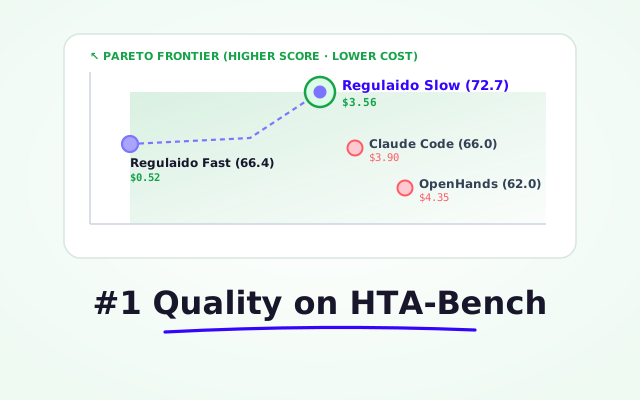
Across the benchmark, Regulaido Engine (Slow) achieves the highest overall quality score while populating every dynamic statutory table and maintaining the lowest hallucination rate. General-purpose coding CLIs (Claude Code and OpenHands) cost more, hallucinate more frequently, and skip roughly a quarter of mandatory tables—while our single-pass Regulaido Engine (Fast) reaches the same score tier as Claude Code at a fraction of the cost.
Notice also that Claude Code's overall score nearly matches Regulaido Engine (Fast), even though Claude Code loses roughly a quarter of the mandatory statutory tables and produces more hallucinations. Because our current automated judge primarily evaluates extracted text and markdown tables rather than full Word layout fidelity, it still under-penalizes broken template formatting and missing structural elements—a limitation we are actively addressing in the next iteration of our evaluation pipeline.
Agent Harness Comparison (All on Gemini 3.8 Flash)
Reference Audit score (0–100), statutory table integrity (135 dynamic tables), verified hallucinations per dossier, and Standard-Tier API cost
| Harness | Score | Tables | Hallu. | Cost |
|---|---|---|---|---|
| Regulaido Engine (Slow) | 72.7 | 100% | 5.0 | $3.56 |
| Regulaido Agent | 67.2 | 96% | 7.0 | $2.71 |
| Regulaido Engine (Fast) | 66.4 | 100% | 6.8 | $0.52 |
| Claude Code | 66.0 | 76% | 8.5 | $3.90 |
| OpenHands | 62.0 | 72% | 11.8 | $4.35 |
Agent Harness Cost–Quality Frontier (Gemini 3.8 Flash)
2. Scaling Frontier LLMs Inside Regulaido Engine
Next, we evaluated four frontier model families—Gemini 4 Argon, Gemini 3.8 Flash, Claude Opus 5.5, and GPT-6 Astra—across low, medium, and high thinking budgets inside Regulaido Engine.
Two clear takeaways stand out from the model sweep: Gemini 3.8 Flash (High) is the cost-efficiency standout at 72.7 / 100 for $3.56 per dossier—outperforming both Claude Opus 5.5 (High) (71.6 at $6.80) and GPT-6 Astra (High) (63.2 at $3.32)—while Gemini 4 Argon (Med) leads overall quality at 75.7 / 100 ($4.50 per dossier, with the lowest hallucination rate of 3.8 per dossier).
Frontier LLM Cost–Quality Frontier Inside Regulaido Engine
3. The Core Engineering Trade-Off: Agent Flexibility vs. Efficiency
Building and benchmarking Regulaido Engine highlighted a fundamental design tension in agentic document generation: how much freedom you give the model to explore versus how tightly you constrain its workflow for cost and speed.
Regulaido Engine (Fast)
Runs a single upfront retrieval pass and populates each section in one structured call. Because it cannot freely decide to inspect an extra 15 pages of a CSR appendix or run follow-up verification queries when a subgroup table looks incomplete, it trades away deeper cross-checks in exchange for speed and minimal cost.
Regulaido Engine (Slow)
Gives each section agent multi-turn freedom to search, read page ranges, inspect upstream drafted chapters, and iteratively refine tables. Quality jumps by +6.3 points on the same Flash model and hallucinations drop, at the cost of higher token consumption and longer runtime.
How we bridge both poles: By extracting and caching a verified shared fact registry and global document strategy up front, every section agent starts on solid common ground and spends multi-turn tool calls only on the genuinely hard gaps.
4. Future Work: Where HTA-Bench and Regulaido Go Next
Both Regulaido Engine and HTA-Bench are active works in progress, and we are expanding them along three axes:
- Expanding to More Drugs and EU HTA (JCA) Dossiers: Our initial eight-dossier benchmark is centered primarily on two complete multi-module AMNOG submissions (Imlunestrant and Omaveloxolon across Modules 1–3), supplemented by Belantamab (Module 3) and Dicycloverine (ICH CTD 2.3.S). We are now expanding the benchmark to a broader, more diverse set of drugs and therapeutic areas—and adding EU HTA Joint Clinical Assessment (JCA) submission templates under Regulation (EU) 2021/2282[26].
- New HTA Lifecycle Tasks — Predicting Richtigstellungen and G-BA Assessments: Writing the initial dossier is only half the battle. We are extending HTA-Bench to evaluate:
- Catching Official Richtigstellungen (Error-Correction Resolutions): Testing whether auditing agents can proactively pinpoint the exact numerical, subpopulation, and table errors in submitted dossiers that later triggered formal G-BA correction resolutions (Beschlüsse zur Richtigstellung).
- Predicting G-BA / IQWiG Benefit Assessments (Nutzenbewertungen) & Drafting Stellungnahmen: Evaluating whether models can anticipate IQWiG methodological critiques from a draft dossier and help teams prepare rigorous written hearing responses.
- Tighter Checks, Template Formatting & Cost Efficiency: On the engine and evaluation side, we are expanding our automated judge to directly audit exact Word template formatting, embedded clinical figures (Kaplan-Meier curves, CONSORT flowcharts), and page-level citation auditability—while continuing to push Regulaido Engine toward a higher quality ceiling at lower cost per run.
We are presenting the full study at ISPOR Europe 2026 in Vienna (Poster Session 2, Monday 9 November, Code HTA86). Explore the continuously updated results on our live HTA-Bench leaderboard, download our ISPOR Europe 2026 poster PDF, or book a session with our team to test Regulaido on your own dossier templates.
References
- [1] Gofman E, et al. Accelerating Global Value Dossier (GVD) Development With Retrieval-Augmented Generative AI (HTA74). Value in Health. 2024;27(12):S372.
- [2] Gofman E, et al. Generative AI Co-Authoring for Disease Burden and Unmet Need Modules in Global Value Dossiers (HTA156). Value in Health. 2025;28(6).
- [3] AI-Assisted Global Value Dossier Authoring: Evaluating Draft Acceleration and Evidence Grounding (HTA169). Value in Health. 2025;28(12).
- [4] Automated Generation of Canadian CADTH Reimbursement Submission Forms Using Large Language Models (SA62). Value in Health. 2024;27(6).
- [5] Comparative Evaluation of Traditional Versus AI-Assisted Health Technology Assessment Dossier Writing (HTA113). Value in Health. 2025;28(6).
- [6] Quality and Efficiency of Generative AI Workflows in HTA Submission Preparation (HTA228). Value in Health. 2025;28(12).
- [7] Automated PICO Mapping and Scoping for European Joint Clinical Assessments Using LLMs (HTA42). Value in Health. 2025;28(12).
- [8] Retrieval-Augmented Evidence Synthesis for EU HTA Joint Clinical Assessment Dossiers (HTA84). Value in Health. 2026;29(6).
- [9] Automated Extraction of Time-to-Event and Survival Outcomes for HTA Submissions (MSR41). Value in Health. 2025;28(6).
- [10] Structured Clinical Trial Evidence Extraction for Joint Clinical Assessments Using Frontier Language Models (MSR204). Value in Health. 2026;29(6).
- [11] Wiehe A, Čuk P, Woeste F. Mapping Writer-AI Conversations for HTA: An Analysis of 12,500 Messages (HTA227). Presented at ISPOR Europe 2025, Glasgow; Value in Health. 2025;28(12). [Poster PDF]
- [12] Čuk P, Wiehe A, Woeste F. Beyond Productivity: How Professional Identity Shapes Generative AI Adoption Among Medical Writing Professionals (HTA53). Presented at ISPOR Europe 2025, Glasgow; Value in Health. 2025;28(12). [Poster PDF]
- [13] OpenAI. Measuring AI Performance on Real-World Economically Valuable Tasks (GDPval / GDP-Bench). Technical Report, 2025.
- [14] Xie T, et al. OSWorld: Benchmarking Multimodal Agents for Open-Ended Tasks in Real Computer Environments. NeurIPS Datasets and Benchmarks, 2024.
- [15] Drouin A, et al. WorkArena: How Capable Are Web Agents at Solving Common Knowledge Work Tasks? ICML, 2024.
- [16] Regenold GmbH. The 2026 EU AI Act Retrieval & Q&A Benchmark Challenge Across 12 AI Systems. 2026. [Companion Blog Post]
- [17] Sharif S, Verhoek A. HELMET: Health Economics and Outcomes Research Large Language Model Evaluation Testbed (P25). Value in Health. 2025;28(6).
- [18] Jin D, et al. What Disease Does This Patient Have? A Large-Scale Open Domain Question Answering Dataset from Medical Exams (MedQA). Applied Sciences, 2021.
- [19] Jin Q, et al. PubMedQA: A Dataset for Biomedical Research Question Answering. EMNLP, 2019.
- [20] Arora R, et al. HealthBench: Evaluating Large Language Models for Real-World Healthcare Conversations. OpenAI Technical Report, 2025.
- [21] Jimenez CE, et al. SWE-bench: Can Language Models Resolve Real-World GitHub Issues? ICLR, 2024.
- [22] Mialon G, et al. GAIA: A Benchmark for General AI Assistants. ICLR, 2024.
- [23] Yao S, et al. τ-bench: A Benchmark for Tool-Agent-User Interaction in Real-World Domains. arXiv:2406.12045, 2024.
- [24] Gemeinsamer Bundesausschuss (G-BA). Verfahrensordnung des G-BA, 5. Kapitel: Bewertung des Nutzens von Arzneimitteln mit neuen Wirkstoffen nach § 35a SGB V (Anlage II: Dossiervorlagen Modul 1–4). [G-BA Templates]
- [25] Angelopoulos AN, Bates S, Fannjiang C, Jordan MI, Zrnic T. Prediction-Powered Inference. Science. 2023;382(6671):669–674.
- [26] European Parliament and Council. Regulation (EU) 2021/2282 on Health Technology Assessment and Amending Directive 2011/24/EU. [EUR-Lex]